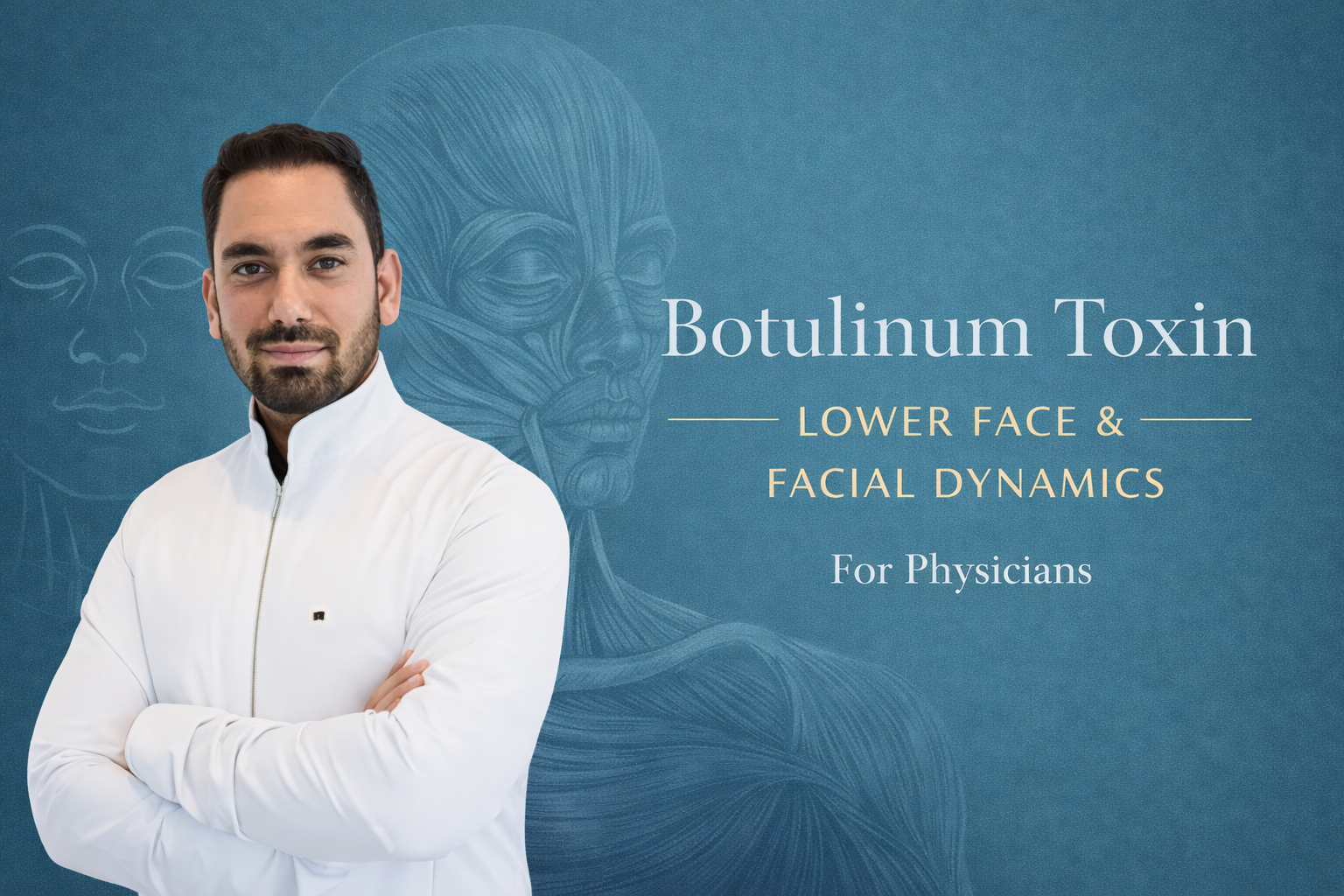
Botulinum Toxine – Level 2: Lower Face & Facial Dynamics
Verlanglijst Delen
Deel cursus
Pagina link
Deel op social media

Over cursus

Botulinum Toxine – Level 2: Lower Face & Facial Dynamics is the natural progression after completing the Fundamentals program. While Level 1 establishes safe practice in the upper face, Level 2 expands clinical competence into the anatomically and functionally complex midface and lower face.

This course focuses on precision, functional preservation, and dynamic facial balance. Unlike the upper face, the lower face is not only aesthetic — it is deeply involved in speech, mastication, emotional expression, and lip competence. Even small dosing errors can lead to visible and functionally significant consequences. For this reason, treatment in this region requires a higher level of anatomical understanding and technical control.

Participants will develop a structured approach to:

  • Gummy smile modulation

  • Depressor anguli oris correction

  • Mentalis treatment and chin dynamics

  • Aesthetic masseter contouring

  • Early platysma modulation

  • Micro-dosing strategies in small functional muscles

Emphasis is placed on vector analysis, muscle interaction, and individualized dosing strategies. Rather than relying on fixed protocols, physicians will learn how to assess facial movement patterns and design treatment plans based on functional anatomy.

This course does not revisit foundational principles such as reconstitution, dilution calculations, upper face injection techniques, or basic complication management. These competencies are assumed to be mastered at Level 1. Instead, Level 2 introduces a more advanced clinical mindset — one focused on controlled modulation rather than simple muscle relaxation.

By the end of this program, participants will be able to treat the mid and lower face with confidence, anatomical precision, and respect for functional integrity — forming the essential bridge toward Expert-level training.

Toon meer

Cursus inhoud

Module 1: Advanced Pharmacology & Immunogenicity
This module builds the scientific foundation of lower face treatment. Participants understand that all type A formulations share the same 150 kDa active neurotoxin core. Clinical effect is determined by intracellular SNAP-25 cleavage — not by complex size or marketing differences. We cover: Molecular structure (heavy and light chains) SV2 receptor binding and intracellular translocation The debated role of complexing proteins Why units are not interchangeable between brands Mechanisms and risk factors for immunogenicity Long-term cumulative dose awareness Core message: Responsible dosing and interval planning protect long-term efficacy.

  • Module 1

Module 2 – Functional Dynamics of the Mid & Lower Face
This module reframes the lower face as a dynamic architectural system. Muscles do not act independently; they operate in vector balance. We analyze: Elevator–depressor interplay Smile biomechanics Motor endplate targeting logic Structural aging vs muscular hyperactivity Emotional expression preservation Core message: Lower face treatment is vector modulation, not muscle paralysis.

Module 3 – Gummy Smile & Midface Elevators
This module focuses on diagnostic precision. Not every gingival display is toxin-responsive. Etiology determines indication. We cover: Muscular vs structural gingival exposure Smile pattern classification (anterior, posterior, mixed) Functional dominance testing LLSAN anatomy and modulation strategy Diffusion risks in the midface Avoiding overcorrection Core message: Subtle 2–3 mm reduction is often ideal — harmony is superior to elimination.

Module 4 – DAO & Depressor Systems of the Lower Face
Here we focus on the emotional vector of the mouth. DAO dominance alters perceived mood. We discuss: Depressor anguli oris anatomy and vector mechanics The modiolus as a convergence point Muscle-driven descent vs structural jowling Safe-zone mapping to avoid DLI diffusion Asymmetry correction logic Emotional perception shifts Core message: DAO modulation shifts vector balance — it does not lift tissue.

Module 5 – Mentalis & Chin Dynamics
This module explores projection and lower lip control. We analyze: Mentalis layered anatomy and depth considerations Grading hyperactivity severity Mentalis vs structural chin retrusion Chin–lip interaction and profile impact Projection changes after modulation Lip incompetence risks Core message: Mentalis treatment affects projection and profile — subtle dosing defines expertise.

Module 6 – Orbicularis Oris & Perioral Dynamics
This is one of the highest-risk aesthetic areas due to functional importance. We cover: Orbicularis oris layered anatomy Dynamic vs static perioral lines Lip flip logic Safe superficial injection zones Speech and articulation risks Treatment sequencing principles Core message: Functional preservation outweighs aesthetic ambition.

Module 7 – Platysma & Cervical Vector Architecture
This module expands into cervical vector control. We examine: Platysma anatomy and inferior pull mechanics Dynamic banding vs structural neck laxity Band classification patterns The Nefertiti principle Marginal mandibular nerve safety Cervical staging strategies Core message: Platysma modulation reduces inferior vector dominance — it does not replace surgery.

Module 8 – Masseter & Lower Face Contour Architecture
This module addresses width, contour, and long-term architectural change. We discuss: Superficial vs deep masseter anatomy Hypertrophy vs skeletal width Bruxism vs aesthetic indications Anterior vs posterior mapping logic Paradoxical bulging Long-term hollowing risk Core message: Masseter treatment reshapes architecture, not bone — long-term planning is essential.

Module 9 – Integrated Lower Face Strategy & Clinical Decision-Making
This final module integrates everything into one decision framework. We cover: Lower face as a vector architecture system Global assessment protocol Structural vs muscular hierarchy Correction sequencing logic Over-treatment pattern recognition Touch-up restraint principles Long-term facial evolution planning When to stop and when to refer Core message: Sequence determines harmony. Restraint defines advanced practice.

Earn a certificate

Add this certificate to your resume to demonstrate your skills & increase your chances of getting noticed.
selected template

Student waarderingen & beoordelingen
Nog geen beoordeling

Want to receive push notifications for all major on-site activities?