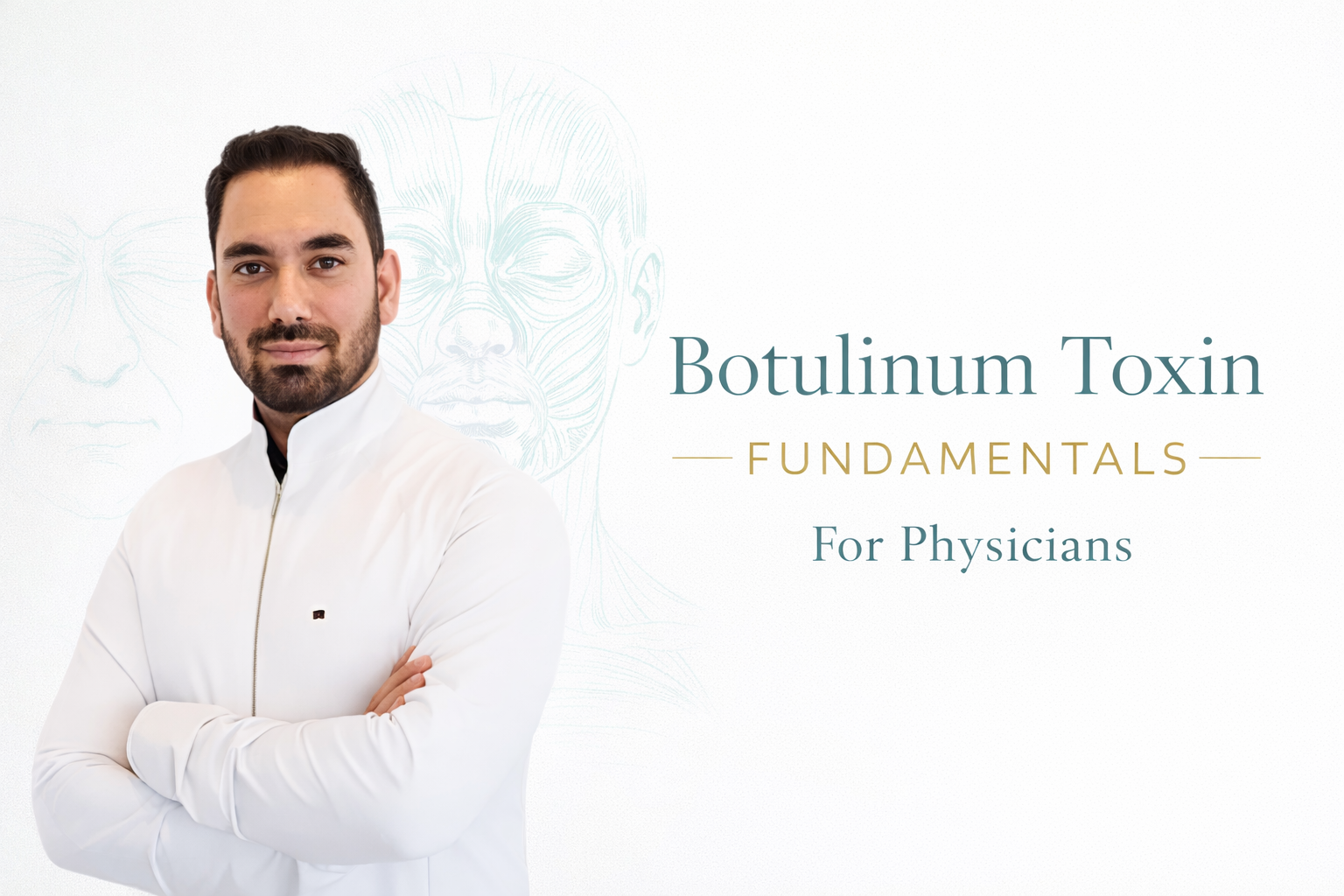
Botulinum Toxin Fundamentals (Level 1)
Verlanglijst Delen
Deel cursus
Pagina link
Deel op social media

Over cursus

Botulinum toxin treatment requires more than memorizing injection points.
Safe and aesthetic outcomes depend on anatomical understanding, dosing precision, and clinical judgment.

This comprehensive online course is designed for physicians who want to build a strong, evidence-based foundation in upper face botulinum toxin treatment before progressing to hands-on clinical practice.

Throughout this program, you will develop a structured understanding of:

• Neuromuscular physiology and mechanism of action
• Facial anatomy and muscle balance
• Dosing principles and dilution calculations
• Structured patient consultation and contraindication screening
• Upper face injection strategy (glabella, forehead, crow’s feet)
• Complication recognition and management
• Clinical workflow and professional integrity

This course focuses on developing clinical reasoning — not just technique.

You will learn how to:

✔ Analyze dynamic muscle activity
✔ Plan treatment strategically
✔ Prevent common complications
✔ Manage adverse events calmly and professionally
✔ Maintain medical integrity in aesthetic practice

Completion of this course prepares you for supervised hands-on training, where theoretical principles are translated into practical injection skills.

Botulinum toxin treatment is not about eliminating wrinkles — it is about understanding muscle function and facial balance.


🎯 Who This Course Is For

• Licensed physicians entering aesthetic medicine
• Doctors seeking structured foundational knowledge
• Practitioners who want to strengthen anatomical and dosing confidence
• Physicians preparing for supervised hands-on training


📚 Course Structure

Module 1 — Fundamentals of Botulinum Toxin
Module 2 — Facial Anatomy for Injectors
Module 3 — Patient Assessment & Consultation
Module 4 — Dosing Principles & Dilution
Module 5 — Upper Face Injection Theory
Module 6 — Complication Recognition & Management
Module 7 — Practical Preparation & Clinical Setup
Module 8 — Clinical Workflow & Professional Development


📥 Included Resources

• Downloadable informed consent template
• Structured consultation framework
• Dilution calculation examples
• Clinical workflow checklist


🏁 Certification

Upon completion, participants receive a certificate of completion in Botulinum Toxin Fundamentals (Online).

This certification qualifies participants to enroll in the supervised hands-on training program.


🎓 Next Step

Clinical competence requires supervised practice.

Participants who complete this course are eligible for the Academy Doctor Yilmaz hands-on training in upper face botulinum toxin treatment.

Toon meer

Wat ga je leren?

  • Understand the mechanism of action of botulinum toxin at the neuromuscular junction
  • Interpret upper face anatomy and muscle balance clinically
  • Conduct a structured aesthetic consultation safely
  • Calculate dilution and dosing accurately
  • Design a treatment strategy for glabella, forehead, and crow’s feet
  • Recognize and manage common upper face complications
  • Apply a structured workflow from consultation to follow-up

Cursus inhoud

Module 1 — Foundations of Botulinum Toxin
Topics: What is botulinum toxin? Mechanism of action (SNARE proteins) Neuromuscular junction Duration of effect Serotypes Units and biological potency Dilution principles Diffusion vs spread Clinical implications Outcome: Participants understand how and why botulinum toxin works.

  • Module 1: Introduction to Botulinum Toxin
    27:48
  • Mechanism of Action
  • Physiology & Recovery
  • History
  • Dilution & Units
  • Spread vs Diffusion
  • Complications & Anatomy
  • Storage & Handling
  • Clinical Reasoning Questions

Module 2: Facial Anatomy for Injectors
This module provides a structured and clinically relevant overview of the functional anatomy of the upper face. Participants develop a clear understanding of the anatomical layers of the face and the unique characteristics of facial expression muscles. The module focuses on the frontalis, corrugator supercilii, procerus, and orbicularis oculi, with emphasis on their origin, insertion, direction of contraction, and interaction within the brow complex. Special attention is given to the dynamic balance between elevators and depressors and how this balance determines brow position. By the end of this module, physicians will be able to: Identify key upper face muscles relevant to botulinum toxin treatment Understand depth variations and anatomical risk zones Recognize how muscle interaction influences aesthetic outcomes Apply anatomical knowledge to reduce complication risk This module reinforces that safe injection begins with anatomical understanding and functional analysis.

Module 3: Patient Assessment & Consultation
This module emphasizes that safe aesthetic practice begins before injection. Participants develop a structured approach to patient assessment, including medical history screening, identification of contraindications, and evaluation of neuromuscular risk factors. The distinction between dynamic and static lines is clarified to support realistic treatment planning. Functional facial analysis at rest and during contraction is integrated into decision-making, with attention to asymmetry and compensatory muscle activity. The module also addresses expectation management and psychological screening, reinforcing the importance of professional boundaries and clinical integrity. By the end of this module, physicians understand that consultation is not a formality but a critical safeguard that influences safety, satisfaction, and long-term outcomes. Safe injection begins with appropriate indication.

Module 4: Dosing Principles & Dilution
This module establishes the principles of precise and safe botulinum toxin dosing. Participants learn that biological effect is determined by total units administered, while aesthetic outcome is influenced by distribution and injection pattern. The distinction between units and volume is reinforced, with emphasis on calculating units per 0.1 mL prior to injection. Dose selection is presented as an individualized clinical decision based on muscle strength, anatomical assessment, gender, treatment history, and baseline brow position. The module highlights the importance of conservative initial dosing, structured follow-up at peak effect, and incremental refinement rather than aggressive first treatment. By the end of this module, participants understand that predictable outcomes depend on calculation discipline, anatomical reasoning, and dose distribution strategy. Precision in dosing creates predictability in results.

Module 5: Upper Face Injection Theory
This module integrates anatomy and dosing into structured upper face injection planning. Participants learn that upper face treatment is not based on fixed injection maps, but on functional muscle assessment and vector balance. The glabellar complex, forehead, and lateral canthal region are analyzed in relation to brow position, muscular compensation, and anatomical risk zones. Special emphasis is placed on the relationship between the frontalis and the depressor muscles. Treating the forehead without evaluating the glabellar complex may increase the risk of brow descent, particularly in patients with compensatory frontalis overactivity. The module also explores injection depth variation, prevention of eyelid and brow ptosis, region-specific distribution strategy, and sequencing of treatment. By the end of this module, physicians understand that injection planning must be individualized and guided by muscle dynamics rather than static templates. Upper face treatment is a balance intervention — not a point-based procedure.

Module 6: Complication Recognition & Management
This module focuses on the recognition, differentiation, and structured management of upper face botulinum toxin complications. Participants learn to distinguish between eyelid ptosis and brow ptosis based on anatomical and functional assessment. Emphasis is placed on understanding the underlying mechanisms of unintended muscle weakening, particularly diffusion toward the levator palpebrae superioris or excessive frontalis inhibition. The module also addresses asymmetry, undercorrection, overcorrection, headache, bruising, and patient dissatisfaction, highlighting the importance of calm clinical reasoning rather than reactive over-treatment. Management strategies are presented in a structured and conservative framework, including appropriate use of apraclonidine in eyelid ptosis, follow-up timing, and communication strategies that maintain patient confidence. This module reinforces that complications are often technical in origin but manageable when anatomy and physiology are understood. Safe practitioners are defined not by the absence of complications, but by their ability to recognize and manage them responsibly.

Module 7: Practical Preparation & Clinical Setup
This module focuses on procedural discipline and environmental control in aesthetic botulinum toxin treatment. Participants learn that complication prevention begins with preparation rather than injection. Proper reconstitution technique, sterile handling, labeling accuracy, and storage awareness are emphasized as critical safety components. Attention is given to syringe selection, needle gauge considerations, depth control, and minimizing mechanical spread during injection. Standardization of workflow is introduced as a method to reduce human error. Participants are guided through structured room setup, documentation protocols, and product traceability to support both patient safety and medico-legal accountability. This module reinforces that technical precision is built upon procedural consistency. Clinical safety begins before the first injection point.

Module 8: Clinical Workflow & Professional Development
This module focuses on structured clinical workflow, long-term treatment planning, and professional responsibility in aesthetic practice. Participants learn that botulinum toxin treatment does not end at injection. Structured follow-up at peak effect (10–14 days) is essential to assess outcome, identify asymmetry, evaluate residual muscle activity, and determine whether refinement is appropriate. The module emphasizes balanced decision-making — avoiding aggressive upselling, resisting overtreatment, and maintaining clinical integrity. Physicians are encouraged to align treatment objectives with both anatomical feasibility and patient priorities. Standardized documentation, photographic comparison, dose tracking, and reproducible workflow protocols are introduced as tools to improve long-term predictability. Finally, the module reinforces that online knowledge provides theoretical readiness, but procedural mastery requires supervised hands-on experience. Professional development in aesthetic medicine is built on repetition, reflection, refinement, and responsible progression. Clinical maturity is measured not by volume of injections — but by consistency of outcomes.

Module 9: Injection Mechanics & Motor Control

Earn a certificate

Add this certificate to your resume to demonstrate your skills & increase your chances of getting noticed.
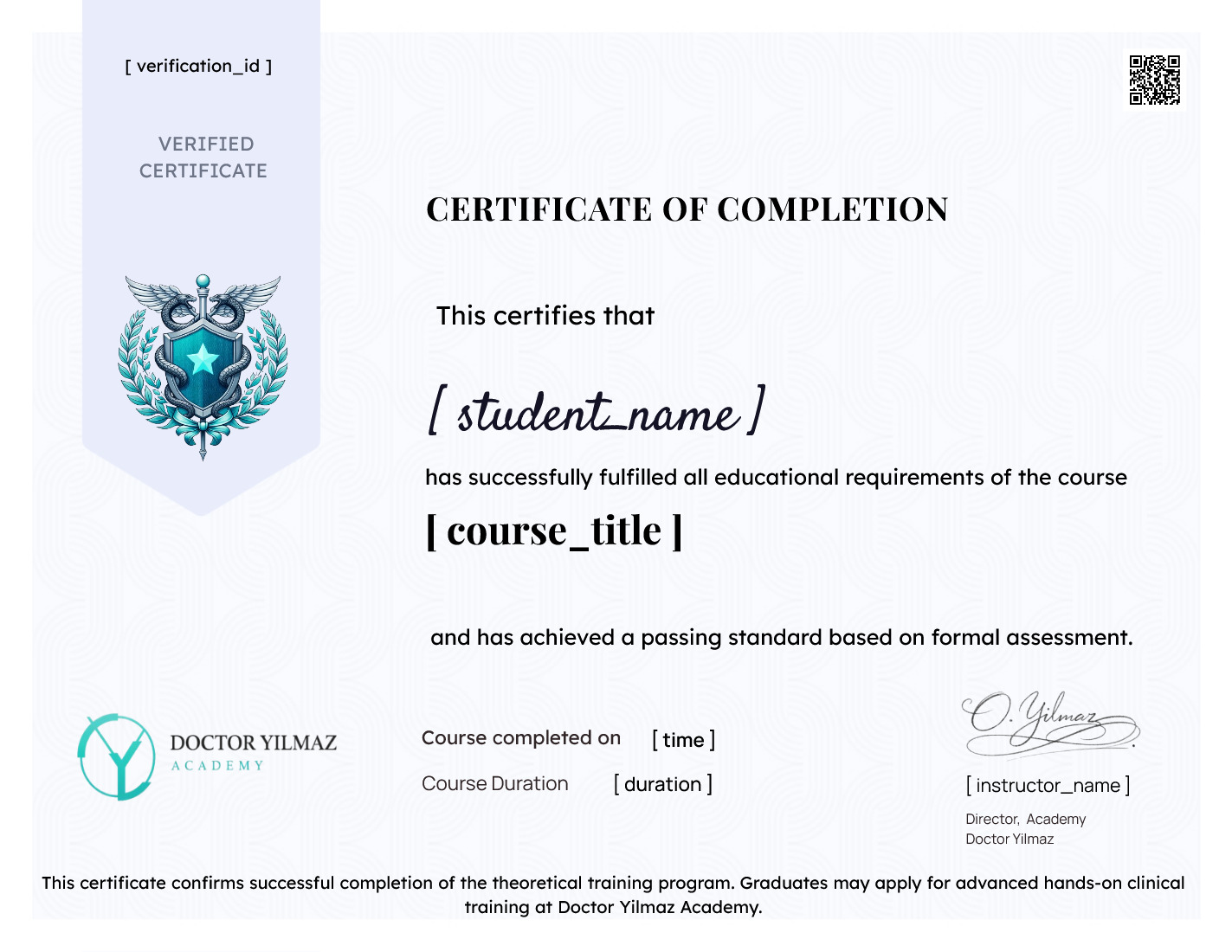
selected template

Student waarderingen & beoordelingen
Nog geen beoordeling

Want to receive push notifications for all major on-site activities?